Nubia is a woman of many talents, and a true creative entrepreneur. As the founder and CEO of Imagine To Dream LLC, she has demonstrated her remarkable ability to turn her passions into successful ventures. Her dedication to literature is evident through her love for writing, which has earned her the title of a published author. Nubia’s creativity extends beyond the realm of writing as she is also an accomplished actress and musician. She has a natural flair for the performing arts, captivating audiences with her charisma and poise. Her music has a soulful quality that resonates with listeners, leaving a lasting impression on their hearts. Her innovative spirit is infectious, inspiring others to pursue their own dreams with passion and perseverance. Nubia’s unique blend of artistic talent and business acumen makes her a force to be reckoned with in the creative industry. Her ability to bring people together and foster a sense of community is truly remarkable. As a trailblazer in the literary world and beyond, Nubia is a shining example of what it means to be a successful creative entrepreneur. Her dedication to her craft and her unwavering commitment to pursuing her dreams are an inspiration to us all.
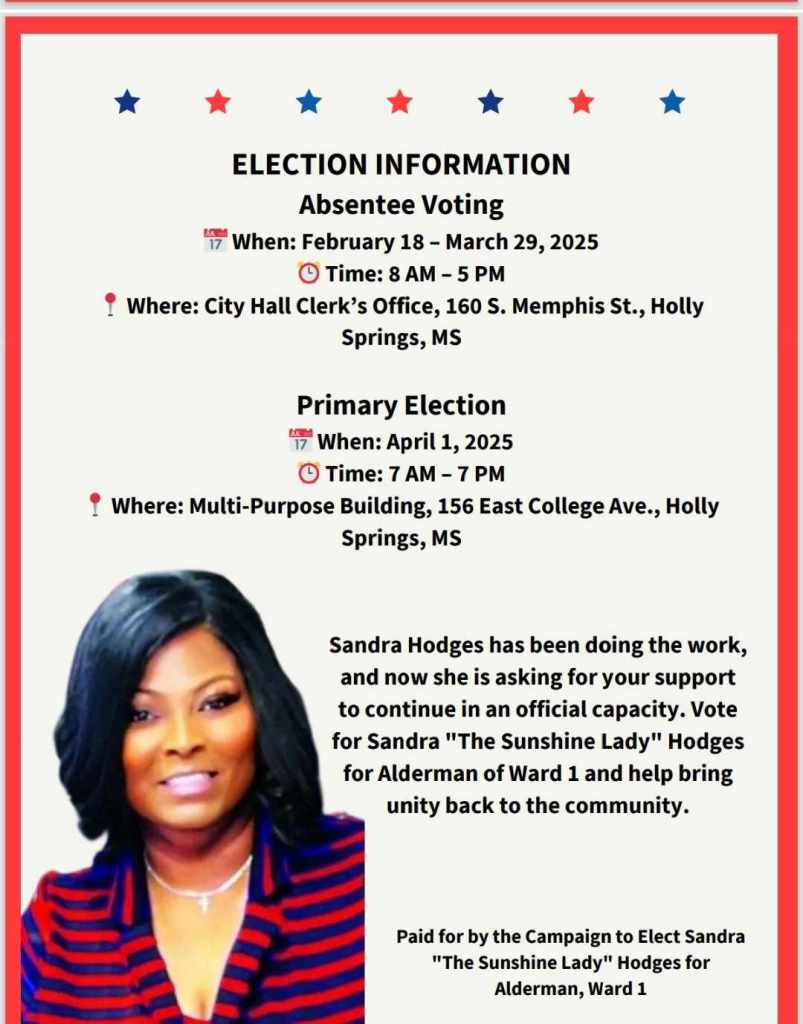
Sandra is a young Democrat that’s running in Ward 1 ready to serve her community more effectively as she’s doing right now being a great Leader in The City Of Holly Springs, Mississippi. She will bring the same mind set and energy to the Aldermans and mayor to help move this city forward in a mighty way, economy, education, affordable healthcare and affordable dental.
Has modern society influenced and impacted our commitment to what makes us whole? There was a time when gender roles shaped the foundation of relationships and provided a simplified blueprint for what it meant to be us.
I remember being a kid and hearing about what was expected of me when I grew up to be a man. I was to work hard, pay the bills, go to church, and watch the game. Love my wife, but make sure she knew I was the head of the house. What I said went. Love was measured differently back then, tied to actions rather than words or emotions. You showed love by keeping the fridge full and the roof over their head. Grab some roses here and there, follow the blueprint, and you’d be fine.
But times have changed. Long gone are the days when the idea of pure, unconditional love—“for better or worse, richer or poorer, till death do us part”—was enough. That love, deeply rooted in the Christian values that shaped it, now feels like a distant memory.
Why?
We live in the Information Age, a time when we know more than ever before. Our brains have become bigger than our minds. We are experts on nothing who claim to know everything. We’ve traded depth for breadth, gaining snippets of knowledge on countless topics but lacking a true understanding of ourselves and our roots.
In this era of self-proclaimed enlightenment, we often look down on previous generations. We ridicule them for keeping their vows and for being content with the simplicity of life. We question everything, and every one of us is exceptional. Everyone is a King or a Queen, and anyone who doesn’t think like us—or agree with us—is dismissed as irrelevant.
We place value on the invaluable, idolizing the superficial. We wear the names of people who wouldn’t acknowledge us if we stood in front of them, decked out in their overpriced clothing. Intrinsic value is a term we like to throw around to sound intellectual, but our actions suggest otherwise. Through our behaviors, we imply that some lives are inherently less valuable than others.
Groupthink Over Individuality
Today, groupthink dominates. It’s the only acceptable way to think. If you dare to reject the consensus of the group nearest you, you’re more likely to be shamed than understood. Social diversity has always existed—cultures influencing cultures—but now it seems that anti-culture has become the new wave. And it’s waving boldly.
Anti-culture rejects the roots that once connected us, opting instead for detachment and rebellion. But in turning away from tradition, what are we building? Are we forging a new path forward, or are we simply drifting further from the values and commitments that once grounded us?
A Deeper Look at Our Roots
I acknowledge that, despite the grandeur of the “old school” blueprint, it wasn’t perfect. Underneath the surface, there was a shadow culture—a hidden layer of issues that were ignored or swept under the rug. Many of the frustrations we have with today’s society were born from that very culture. But there’s a benefit to the light being shone on those shadows and the rug being pulled back to reveal the trash beneath.
Yes, we’ve drifted from our roots, but if we’re being honest, that drift started a long time ago. Should we go back to the ways of old and try to do things “right” this time? That depends on who you ask. As for me, I believe we need to sit with yesterday’s society, have an honest conversation about its strengths and flaws, and reflect deeply on how we can improve today’s society to make tomorrow’s even better.
Let’s Return to Genuine Connection
And no, this conversation doesn’t belong on social media. Let’s get back to house visits, genuine connections, and real conversations. Let’s return to proper value placement—respect, understanding, empathy, faith, and love for our fellow human beings.
Let’s take all the information we’ve gained and structure it for the good and betterment of us all, not just the selfish individual. If we can shift our focus from “me” back to “us,” perhaps we’ll find the balance we’ve been missing and create a society we can all take pride in.
“Our differences were formed by ‘The Creator’ which allows us to be perfectly imperfect”
Diversity: A Reflection
In the context of race, diversity refers to the inclusion and representation of people from different racial and ethnic backgrounds, each bringing their unique experiences, perspectives,and cultures. It emphasizes the value of acknowledging, respecting, and celebrating these differences to promote equity, mutual understanding, and inclusivity in a society, organization, or community.
At first glance, this seems like a simple and fair definition. But as I read it again, I noticed something—it doesn’t take into account individuals. Why is that? I wonder if introducing the complexities of individual identity might make the concept harder to untangle. Perhaps that’s why diversity often focuses on groups rather than specific people.
As a tool, diversity seems to work well in many ways. But it also has limitations, and I believe those limitations can sometimes be dangerous. When I watch discussions about diversity—whether celebratory or critical—I often hear statistics and data dominate the conversation. When individuals try to share their specific life experiences, those stories are often overshadowed by the numbers. While data can reveal systemic patterns, this approach sometimes leaves me disappointed because it seems to miss the human element.
I’m also not a fan of phrases like “Black people” or “White people.” To me, these terms fail to capture the true diversity within these groups. How could they? People’s experiences are shaped by so many factors beyond their racial identity. A person raised within a particular context—be it geographic, socioeconomic, or cultural—is likely to reflect the influences of that context more than just their race.
And what about culture? This question feels loaded and overly simplified. Take “Black culture,” for example. Too often, it’s portrayed with negative stereotypes: toxic, lazy, uneducated, uninformed, unruly, or weak. These harmful associations are perpetuated by certain genres of popular music, historical biases in media, and broader societal narratives. For those outside the Black community, these stereotypes often become the default perception, fueling misunderstanding and disdain.
At the same time, there’s another side to Black culture that can’t be ignored—one of resilience, creativity, and innovation. It’s found in the art, music, and traditions that have shaped global culture. It’s in the shared sense of community and the fight for justice that has inspired countless movements. This is why it’s important to approach culture with nuance: to challenge harmful stereotypes while celebrating the richness and diversity within it.
Diversity of race or color is valuable—don’t get me wrong. But I think a better, albeit more challenging, focus would be diversity of thought. Understanding people as individuals, with their own specific stories, perspectives, and values, is crucial. However, I also recognize that systemic issues often affect groups collectively. Focusing on group-level diversity can help address systemic inequities, while an emphasis on individuality ensures that people aren’t reduced to mere categories.
All that said, I do believe diversity is important and necessary. It’s a starting point for creating equity and inclusion. But we can’t stop there. To truly embrace diversity, we need to listen deeply, think critically, and go beyond surface-level representations. Because at the end of the day, people from everywhere are amazing in their own unique ways.
Over the past decade or so, there has been a lingering sentiment that “hip-hop is dead.” Well, fortunately for us, the soul is still alive and fortunately for the people that still believe in music from the heart that contains purity in expression-flaws included, artists like Sky Whatley exist.
One of the greatest things about being an artist is the ability to change and become who you want to be. No one’s music collection should only have one type of artist, and artists shouldn’t be pigeons held to sound one way. During his earlier years Sky Whatley (previously gone by the name of Nut Skywalker) had a sound that was coined as “hood rock.” Proof that rock and hip-hop aren’t distant relatives at all, but very closely knit and related.
Now, as all artists have a right to, Sky Whatley is seeking expression from his other love: Soul music. Inspired by greats like Prince, Sly Stone and Steven Tyler of Aerosmith.
This may be something that his initial fan base may not be aware of after his sleuth of popular songs like “I’m Rick James Bitch” and “Chevy Game” featuring ex-Poison Clan member JT Money. When his “Hood Rock” project was released, Sky Whatley suggested that he wasn’t “making just an album but a flip on the entire music industry.”
His new direction will incorporate soul with a gospel edge that proves that honest music doesn’t have to lack quality. Sky Whatley further admits that he makes his music with “natural talent” and adds “no auto-tunes.”
In a time where real artists are too far and in between and flash-in-the-pan hopefuls are on every Facebook page looking for a friend request. Sky Whatley has other plans as a singer/producer/ songwriter and with notable collaborations under his belt including Fabo, Lil Jon, Goodie Mob, B.O.B.
2022 offers to be a year filled with new hopes for Sky Whatley and his new music is going to reflect the sounds of his fan-base: Eclectic, energized and unpredictable. That’s what real music is supposed to be. -PJ
Presently Sky Whatley is still booking shows and collaborating with others to expand the platform of the industry. He believes it is important to sometimes share the stage with others to exemplify by example severity of working together for the greater cause and in this case it is ‘music’.






 Letha's Real Talk